Business Hours: Mon-Fri, 8am-4:30pm & Sat, 8am-1:00pm, Sunday Closed


Fire doors are critical parts of a building’s fire safety standards, and are key to ensuring effective and legally compliant fire protection systems across the site.
Not only do they ensure that, in the event of an emergency, fires are safely contained and compartmentalised, but they work to protect fire escape routes, enabling anyone on the site to escape in a safe, orderly and direct way. Furthermore, fire doors (alongside their sufficient maintenance and ongoing testing) are a core component of building regulation compliance, and these details will often be required by your insurance company (if you are submitting an insurance claim as a result of a fire).
So, as you can see, it is vital that any fire doors on your site are being tested regularly and thoroughly.
Below, we have shared a complete guide to fire door testing and fire door regulations. By following these steps, you can ensure your business is attaining the highest fire safety standards.
Fire doors enable buildings to be compartmentalised. When they are in place, the spread of fire across the building is significantly delayed.
What’s more, the fire doors can be strategically placed, to delay fire from reaching key safety areas (such as fire exit routes).
As such, fire doors are positioned in specific, strategic locations. However, in order to perform effectively, every single fire door needs to be performing as it should.
By regularly testing your fire doors, you can ensure that:
One of the most common types of ratings for fire doors is those provided by the British Woodworking Federation (BWF).
The main BWF fire ratings for fire doors are:
The number following the letters ‘FD’ represents the length of time that the door can provide fire protection for (in number of minutes). For example, an FD120 fire door can provide fire protection for at least 120 minutes.

One of the primary regulations that fire doors need to meet in the UK is that they achieve the FD30 classification standard at the minimum.
All fire doors must be tested in accordance with either BS 476-22:1987 or BS EN 1634-1:2014.
For a fire door to meet regulatory requirements, it needs to be tested following the fire door tested methods as defined in either BS 476-22:1987 or BS EN 1634-1:2014.
These tests must be conducted by an independent body, which has the authority to grant official fire performance ratings.
The standard testing process for fire doors is as follows:
It is important to note that these tests are conducted on the entire door set (both the door and the frame), and all of the door’s hardware.
This means that, if any part of the door or its components are altered, then its FD rating no longer serves as a guarantee of how it will perform in the event of a fire.
If you have any further questions about fire door regulations and fire door testing, or you are looking to improve the fire safety standards of your site, speak to Access Innovations today.
Contact our team for a quote, or visit our fire door inspection page for more information.

Industrial doors are a fantastic, efficient and dependable addition to an industrial site. However, all too often, these units are overlooked until something goes wrong. Even the highest quality industrial doors are at risk of failure, especially if they are not appropriately maintained. Common issues include roller shutters failing to open, automatic doors no longer […]
Read More… from What Is a Pre-Planned Maintenance Contract for Industrial Doors and Do You Need One?

“It’s working fine — why spend money on maintenance?” If your door is working just fine, it’s easy to see why it might be tempting to skip spending money on maintenance. It’s a common mindset. But in reality – especially in commercial premises – if your security doors, roller shutters, or automatic entrances start functioning […]
Read More… from The Hidden Cost of Skipping Annual Door Maintenance
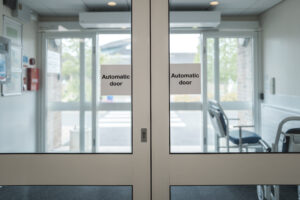
Automatic doors are now a staple feature in commercial sites. They feature across all types of commercial buildings, and sites of all sizes, use cases and requirements. This is because automatic doors offer a huge range of invaluable benefits. Not only do they make sites accessible for visitors with different needs, but they are also […]
Read More… from Automatic Doors Guide: Different Types & Benefits for Commercial Use
 0800 086 2463