Business Hours: Mon-Fri, 8am-4:30pm & Sat, 8am-1:00pm, Sunday Closed

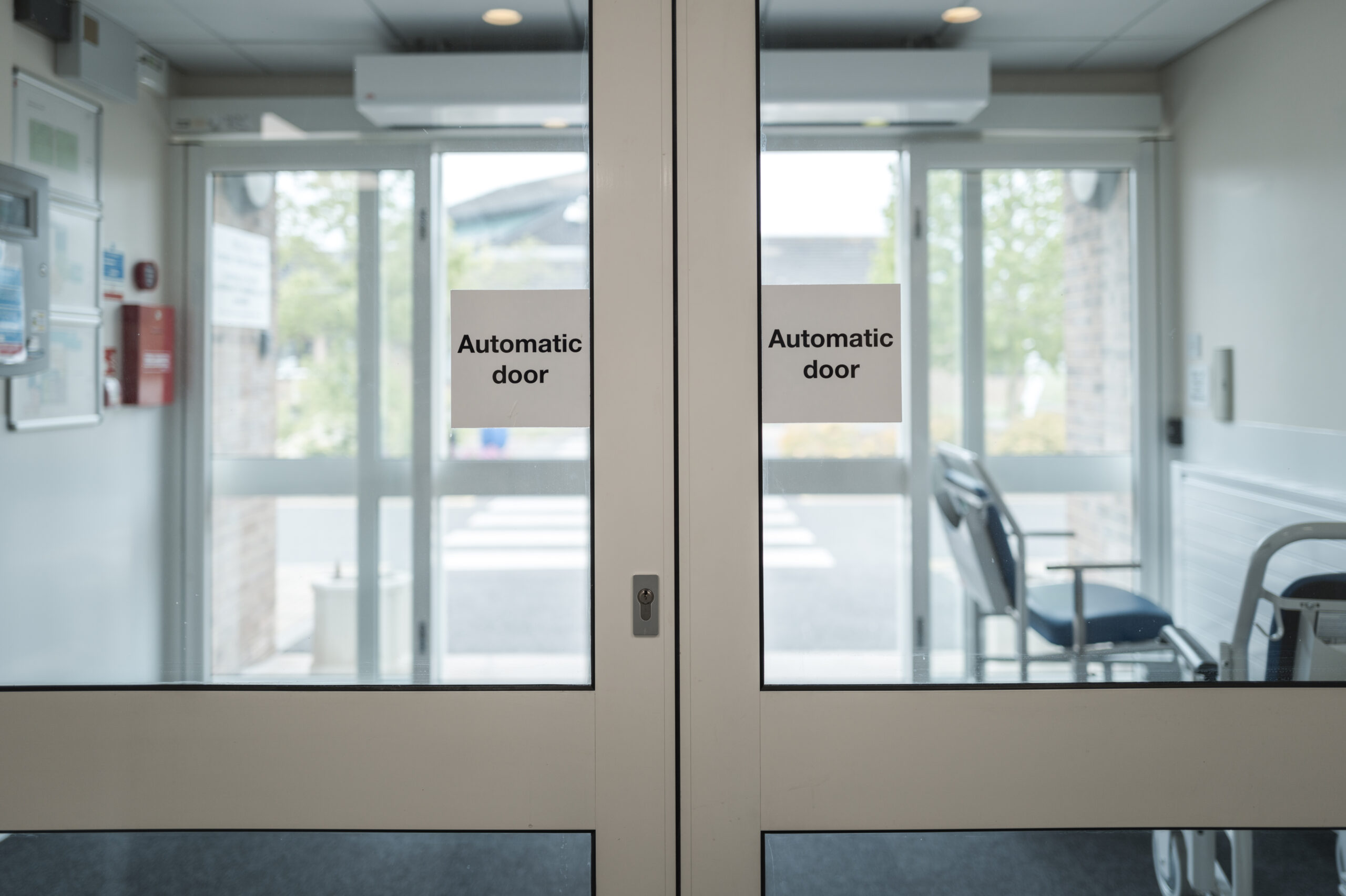
Automatic doors are now a staple feature in commercial sites. They feature across all types of commercial buildings, and sites of all sizes, use cases and requirements.
This is because automatic doors offer a huge range of invaluable benefits. Not only do they make sites accessible for visitors with different needs, but they are also a key part of improving site safety, convenience and traffic flow.
There are three main types of automatic doors – sliding, swing and telescopic automatic doors.
In this guide, Access Innovations’ expert team have outlined how these doors work, their most common use cases, and their typical maintenance requirements.
Sliding automatic doors feature one or more panels, which move horizontally along a track. They can be activated by either sensors or push pads (or other access controls, if required), and are designed to easily accommodate high traffic. Plus, thanks to their barrier-free entry, they are ideally suited to ensuring full compliance with accessibility requirements.
Sliding automatic doors are the most common type of automatic doors used in commercial settings, and they can be configured as single sliding doors, bi-parting doors (where the panels move apart to open), or as fixed side screens with moving panel(s).
What sectors most commonly use sliding automatic doors?
What are the most common issues with sliding automatic doors?
Note that, by arranging regular automatic door servicing, you can minimise the risks of these issues. Plus, by identifying any signs of wear early, these issues can be tackled proactively, preventing costly repairs or downtime later down the line.
Swing automatic doors operate in the same way as traditional hinged doors, but with automated opening and closing. They use an electric operator to enable the doors to automatically swing inwards, outwards or in both directions (depending on the configuration and the specific requirements of the site).
What sectors most commonly use swing automatic doors?
What are the most common issues with swing automatic doors?
Telescopic automatic doors are another type of sliding door. But, these open by multiple panels sliding and stacking behind each other.
They are designed to maximise the opening of the door, creating a wide and completely clear entry point. But, because of their more complex design, professional installation is key to ensuring that the panels move in a smooth, synchronised fashion.
What sectors most commonly use telescopic automatic doors?
What are the most common issues with telescopic automatic doors?
Whatever your preferred type of automatic door, professional installation is absolutely critical to ensuring all of the door’s mechanisms are correctly calibrated. Without a doubt, this is the most effective way to ensure safe, reliable and efficient long-term performance for automatic doors.
By arranging professional installation and servicing schedules, your business can:
At Access Innovations, our expert team of automatic door specialists provide a comprehensive service, including installations of new doors, plus ongoing servicing and maintenance schedules.
With their support, you can ensure dependable long term performance for your automatic doors, and maximise your investment.
To find out more, get in touch with our team.

In the UK, the entry and exit areas for commercial buildings are subject to stringent legal safety requirements, particularly when it comes to fire safety. These safety laws are designed to ensure dependable and standardised performance in the event of an emergency. They also ensure that key parts of a building – like doors, for […]

Industrial doors are a fantastic, efficient and dependable addition to an industrial site. However, all too often, these units are overlooked until something goes wrong. Even the highest quality industrial doors are at risk of failure, especially if they are not appropriately maintained. Common issues include roller shutters failing to open, automatic doors no longer […]
Read More… from What Is a Pre-Planned Maintenance Contract for Industrial Doors and Do You Need One?

“It’s working fine — why spend money on maintenance?” If your door is working just fine, it’s easy to see why it might be tempting to skip spending money on maintenance. It’s a common mindset. But in reality – especially in commercial premises – if your security doors, roller shutters, or automatic entrances start functioning […]
Read More… from The Hidden Cost of Skipping Annual Door Maintenance
 0800 086 2463