Business Hours: Mon-Fri, 8am-4:30pm & Sat, 8am-1:00pm, Sunday Closed


In the UK, the entry and exit areas for commercial buildings are subject to stringent legal safety requirements, particularly when it comes to fire safety.
These safety laws are designed to ensure dependable and standardised performance in the event of an emergency. They also ensure that key parts of a building – like doors, for example – operate in an efficient and clear way, so that any individuals in the building can get out quickly and safely.
In addition to the doors themselves, these laws also cover the exit hardware that is used in the door. The type of hardware that’s required will largely depend on who is using the building.
For instance, a workplace that is occupied by trained staff has different requirements to a shop, school or public building (where visitors may not be familiar with the layout of the building).
In this article, Access Innovations’ expert team have outlined the differences between the main types of safety exit hardware, so that you can better understand what your fire door will require.
A panic bar is a horizontal bar, which is fitted across the inside of a fire exit door.
This allows someone to open the door by simply pushing against the bar. As such, they are extremely easy to use and figure out how they work.
Panic exit devices like these are covered by BS EN 1125. They are designed to work within buildings where the exit may be needed by people who aren’t familiar with the building.
This is why panic bars are commonly seen in retail sites and entertainment venues, schools, public buildings and other sites visited by members of the public.
Rather than featuring a full horizontal bar, a push pad allows the user to operate the door using a smaller pad or lever. The user can simply push the marked pad to open the door.
These emergency exit devices are covered by BS EN 179.
The key difference is that push pads are generally deemed to be better suited to buildings where most people are familiar with the escape routes, and have had training on how to exit the building in an emergency.
So, in a controlled workplace with trained employees, they can use push pads or lever-operated exit devices (rather than a panic bar).

The main difference between how BS EN 1125 and BS EN 179 applies is the people using the building, and whether they can be expected to understand how the exit works.
Then, the Regulatory Reform (Fire Safety) Order 2005 states that it is the duty of the responsible person to ensure that suitable fire precautions are in place and are suitably maintained. This includes escape routes and hardware on the doors.
As a result, it is a legal requirement for both fire exit doors and their hardware to be kept in good working order. It’s also critical that any hardware that is fitted to a fire door is compatible with the door’s tested certification.
Furthermore, if you were to swap an existing hardware with a different type of exit device – without checking compatibility – installing an unsuitable device could invalidate the fire door’s certification, and its ability to perform in the event of an emergency.
If you need to check whether your fire exit hardware is compliant, the CE/UKCA marking is a quick and clear way to check compliance.
When choosing an exit hardware, check whether the product carries the appropriate CE or UKCA marking.
Alongside this, you’ll also need to consider the type of fire door, its fire rating, and what the building is used for.
Generally speaking, a panic bar fire door is more appropriate for sites that often have members of the public visiting (or other people who would not be familiar with the building). This is the safest choice, ensuring it is easy for them to identify how to exit the building.
Whereas a push pad or lever-operated device can be used in a controlled workplace, where people on site are familiar with the building and have received training for emergency exit procedures.
However, you should also consider factors including occupancy levels, escape routes, door configuration and the type of fire door. So, a professional site survey is the safest way to confirm what hardware is the best fit for your building.
At Access Innovations, we provide a range of professional fire door services, including specifying and fitting both of these hardware types. Our skilled, fully trained team help businesses across the country to select, install and maintain the best-fit solutions for their premises.
To find out more, contact our team and arrange a professional assessment.

Industrial doors are a fantastic, efficient and dependable addition to an industrial site. However, all too often, these units are overlooked until something goes wrong. Even the highest quality industrial doors are at risk of failure, especially if they are not appropriately maintained. Common issues include roller shutters failing to open, automatic doors no longer […]
Read More… from What Is a Pre-Planned Maintenance Contract for Industrial Doors and Do You Need One?

“It’s working fine — why spend money on maintenance?” If your door is working just fine, it’s easy to see why it might be tempting to skip spending money on maintenance. It’s a common mindset. But in reality – especially in commercial premises – if your security doors, roller shutters, or automatic entrances start functioning […]
Read More… from The Hidden Cost of Skipping Annual Door Maintenance
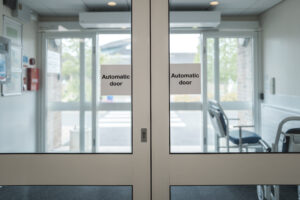
Automatic doors are now a staple feature in commercial sites. They feature across all types of commercial buildings, and sites of all sizes, use cases and requirements. This is because automatic doors offer a huge range of invaluable benefits. Not only do they make sites accessible for visitors with different needs, but they are also […]
Read More… from Automatic Doors Guide: Different Types & Benefits for Commercial Use
 0800 086 2463