Business Hours: Mon-Fri, 8am-4:30pm & Sat, 8am-1:00pm, Sunday Closed


Industrial doors are a fantastic, efficient and dependable addition to an industrial site.
However, all too often, these units are overlooked until something goes wrong.
Even the highest quality industrial doors are at risk of failure, especially if they are not appropriately maintained.
Common issues include roller shutters failing to open, automatic doors no longer operating, or fire-rated doors failing a safety inspection.
To protect your business against the risk of downtime or legal compliance issues, you should ensure that industrial door maintenance is established on a routine basis, and that preventative maintenance is baked into your operations.
At Access Innovations, we specialise in the supply, installation, maintenance and repair of industrial shutters and doors.
In this article, our skilled team have shared their advice for best practice industrial door maintenance. This includes outlining what a Pre-Planned Maintenance Contract is, what it covers, and why it is such an invaluable asset for businesses.
A pre-planned maintenance contract (a PPM contract) is a scheduled programme of servicing.
In the case of industrial and commercial doors, this contract is designed to keep the units operating at peak performance levels for the long term, minimising the risk of failures, downtime or unexpected issues being allowed to escalate.
With these contracts, you can keep your doors running safely, efficiently and compliantly throughout their predicted lifespan.
These pre-planned maintenance visits consist of qualified engineers conducting inspections and maintenance visits on a regular, routine basis.
These experts then assess all elements of the door, with the intention of identifying any potential signs of wear or faults, and addressing them before they are able to escalate into a larger or more expensive issue.
Typically, a contracted PPM visit will include:
As you can see, PPM contracts are designed to help facilities managers, operations managers and commercial property managers manage the risks of these doors in a comprehensive, proactive way.
A critical advantage of arranging a PPM contract is its ability to keep your business fully compliant, with minimal stress or hassle at your end.
In the UK, industrial doors fall under ‘work equipment’. As a result, they are usually governed under the legal requirements outlined in the Provision and Use of Work Equipment Regulations (PUWER).
As a result, part of a business’s legal responsibility is ensuring that such equipment is being maintained in a safe condition. With a PPM contract, regular inspections keep the unit working correctly, while the associated documentation and reports provide proof of responsible management if required.
For fire-rated doors, ongoing inspection and maintenance is particularly critical. During audits of inspections, businesses must prove that they remained compliant with all associated fire safety legislation.
With a PPM contract, businesses gain a clear service history and an auditable record of all inspections, maintenance activities and any required repair work.
If we compare these two approaches to maintenance, the differences are stark:
Almost all commercial and industrial doors can benefit from PPM contracts.
This includes any door that plays a key role in site safety, security, fire prevention or daily operations.
Common examples include:
If these door types are present in your site, and you’re currently dependent on reactive repairs, a PPM contract could bring significant safety and security improvements to your site.
With these planned maintenance contracts, you can minimise the risk of costly downtime or major repairs, while improving the safety standards for everyone on your site.
At Access Innovations, our professional team provides industrial door PPM services throughout Birmingham, Coventry and the rest of the West Midlands.
We are trusted by countless business owners across the region to keep their critical door systems operating safely, efficiently and compliantly.
To find out more, or to arrange a PPM contract for your site, don’t hesitate to get in touch.

In the UK, the entry and exit areas for commercial buildings are subject to stringent legal safety requirements, particularly when it comes to fire safety. These safety laws are designed to ensure dependable and standardised performance in the event of an emergency. They also ensure that key parts of a building – like doors, for […]

“It’s working fine — why spend money on maintenance?” If your door is working just fine, it’s easy to see why it might be tempting to skip spending money on maintenance. It’s a common mindset. But in reality – especially in commercial premises – if your security doors, roller shutters, or automatic entrances start functioning […]
Read More… from The Hidden Cost of Skipping Annual Door Maintenance
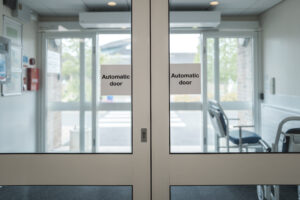
Automatic doors are now a staple feature in commercial sites. They feature across all types of commercial buildings, and sites of all sizes, use cases and requirements. This is because automatic doors offer a huge range of invaluable benefits. Not only do they make sites accessible for visitors with different needs, but they are also […]
Read More… from Automatic Doors Guide: Different Types & Benefits for Commercial Use
 0800 086 2463