Business Hours: Mon-Fri, 8am-4:30pm & Sat, 8am-1:00pm, Sunday Closed

Dock levellers are a widely used industry solution, helping industries with heavy lifting operations to protect their staff and improve the efficiency of their operations.
Dock levellers work by providing a moveable platform, which can be lifted and dropped when required. This acts as a bridge, between a loading bay and a vehicle, making it infinitely easier for heavy loads to be lifted onto docked vehicles.
At Access Innovations, we specialise in the repair and installation of dock levellers, shocks and bumpers, providing our professional services across the country.
As such, we offer a wide range of loading dock levellers, designed to best meet the unique requirements of your site.

To help you find the best loading dock leveller for your operations, keep reading. Below, we’ve outlined the different types of loading dock levellers available for you to buy, and the specific use cases of each.
Operators can control hydraulic dock levellers through the push of a button. Using the control panel, the leveller can be raised and lowered, and the lip either extended or stored.
This type of dock leveller is precisely designed for high intensity workloads. They are made for operations that are busy, and lift heavy loads. Plus, they can be used in any weather, even extreme conditions.
So, they are an extremely versatile solution, which are widely used in warehouses and outdoor environments. However, due to their higher cost, the investment isn’t usually worthwhile for low intensity operations with lighter loads.
Truck levellers are a type of hydraulic dock leveller. But, as their name suggests, they are designed for trucks.
These dock levellers are usually wider and lower, in order to better suit the positioning of a truck. This will ensure that the dock leveller performs its task as efficiently and safely as possible.
Instead of a hydraulic system, air dock levellers use inflating air bags to raise the deck.
When you push a button, the airbag will inflate. Then, the deck is raised and the lip is deployed. To lower, the airbag deflates and the reverse happens.
Like their hydraulic counterparts, air dock levellers can be used in extreme temperature environments, and are well equipped for medium-heavy use.
Their main benefit over hydraulic dock levellers is that they come at a much lower price point. However, the airbag needs to be cleaned regularly and can be more prone to breakdown.
Meanwhile, mechanical dock levellers use a chain. Rather than using a power source, they work by using springs to lift and lower the leveller.
They are the most affordable type of dock leveller, and are highly functional. They can be used in a wide variety of settings, and will save you a lot of money (both in the initial purchase, and in energy savings).
However, the drawbacks of mechanical loading levellers are that they require regular maintenance schedules, and will need routine lubrication.
If you have any questions about loading bay dock levellers, or are struggling to choose the right option for your operations, the Access Innovations team is here to help.
If you require our services, or just some professional guidance, don’t hesitate to get in touch.
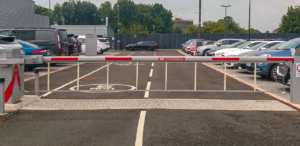
If you’re looking to improve vehicle access control at your site, one of the first decisions you’ll need to make is whether you should install an automatic barrier or a gate. Generally, rising arm barriers are the best choice for sites where fast, regular traffic flow is the priority. In comparison, gates are a better […]

In the UK, the entry and exit areas for commercial buildings are subject to stringent legal safety requirements, particularly when it comes to fire safety. These safety laws are designed to ensure dependable and standardised performance in the event of an emergency. They also ensure that key parts of a building – like doors, for […]

Industrial doors are a fantastic, efficient and dependable addition to an industrial site. However, all too often, these units are overlooked until something goes wrong. Even the highest quality industrial doors are at risk of failure, especially if they are not appropriately maintained. Common issues include roller shutters failing to open, automatic doors no longer […]
Read More… from What Is a Pre-Planned Maintenance Contract for Industrial Doors and Do You Need One?
 0800 086 2463